
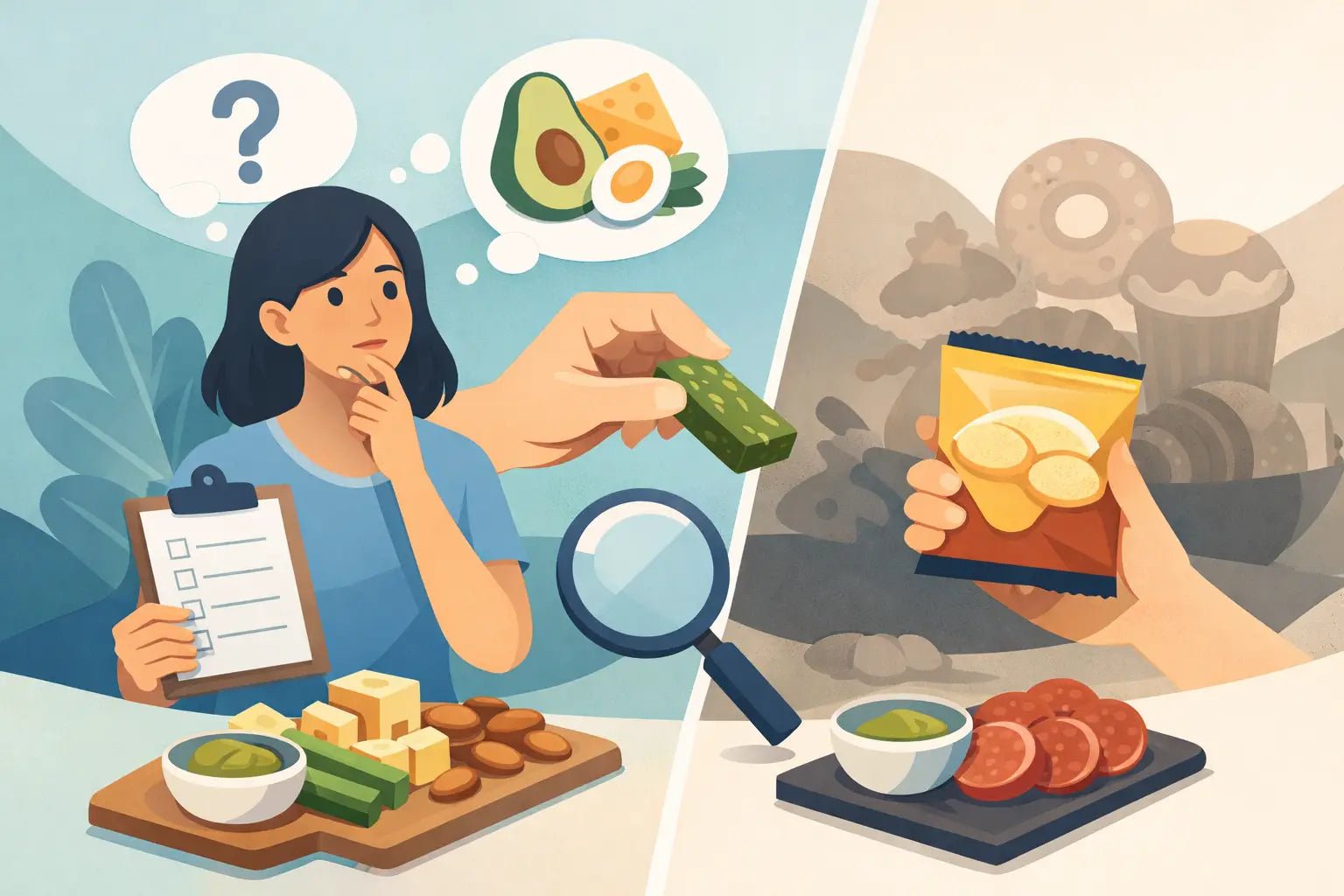
That 3 pm hunger can make a snack bar with a glossy “natural” label look far more keto-friendly than it is. Learning how to choose keto snacks means looking beyond the front of the packet, so you can keep convenient food on hand without accidentally spending your day’s carb budget on a supposedly healthy treat.
The good news is that keto snacking does not have to mean dry nuts in the bottom of your bag or saying no to every crunchy, chocolatey or savoury craving. You’re in the right place for satisfying options. The trick is matching the snack to your carbohydrate tolerance, your ingredients preferences and the moment you need it for.
Start with the nutrition panel, not the marketing
Words such as “low sugar”, “protein”, “natural” and even “keto friendly” can be useful clues, but they are not the final call. Turn the pack over and check the nutrition information panel first.
For most people following keto, the key number is carbohydrates per serving. Your personal target may be quite strict, especially if you are new to keto, actively tracking ketones or managing carbs for a particular health goal. Others following a more relaxed low-carb or LCHF approach may have more room. There is no single snack carb number that works for every person, but a snack that uses a large portion of your daily allowance needs to earn its place.
Also check the serving size. A small bag of crackers may list very low carbs per serve while containing two or three serves. A chocolate block might have a sensible portion marked out, but it is easy to eat several squares while watching telly. Compare the per-serve figure with the amount you would realistically eat, not the amount the packet hopes you will eat.
Australian nutrition panels generally list fibre separately from carbohydrates, which makes label reading more straightforward than it can be elsewhere. Still, ingredients matter, particularly when a product contains sweeteners or sugar alcohols.
Know which ingredients fit your version of keto
A keto snack should be low in digestible carbs, but that is only the starting point. Its ingredients influence how filling it is, how it tastes and whether it suits your body.
Look for familiar keto-friendly foundations such as nuts, seeds, cheese, coconut, cacao, olive oil, butter, cream, eggs, meat, collagen or low-carb fibres. These can provide fat, protein or texture without relying on conventional flour and sugar.
Sweet snacks often use alternatives such as stevia, monk fruit, erythritol or allulose. Each has a different taste and tolerance profile. Monk fruit and stevia are intensely sweet and used in tiny amounts, often alongside other ingredients to round out the flavour. Erythritol has minimal impact on blood glucose for many people, but some find it leaves a cooling sensation or causes digestive discomfort in larger amounts. Allulose is another lower-carb option that behaves more like sugar in recipes, though tolerance still varies.
Be cautious with ingredients that can add up quickly: sugar, glucose, rice syrup, tapioca syrup, honey, dates, maltodextrin, maltitol and starches made from rice, potato or corn. A product can be sugar-free and still contain carbohydrate sources that do not suit a ketogenic approach. “No added sugar” is not the same as low carb.
Sugar alcohols deserve a closer look
Not all sugar alcohols behave alike. Maltitol is commonly used in sugar-free confectionery, but it can affect blood glucose more than erythritol or allulose and may cause a rushed trip to the loo for some people. If you are testing ketones, closely managing carb intake or simply learning your own response, it is worth being selective rather than assuming every sugar-free lolly is a free-for-all.
That does not mean you need to fear every sweetener. It means choosing products with clear labelling, trying a sensible portion and noticing how you feel afterwards. Keto is easier to sustain when your snacks agree with you.
Choose keto snacks that actually satisfy
A low-carb snack that leaves you hungrier 20 minutes later is not always a great buy. The most useful options have enough protein, fat, fibre or crunch to bridge the gap until your next meal.
For a savoury snack, cheese crisps, pork crackle, seed crackers, roasted nuts or a protein-based chip can provide the salty crunch many people miss. Compare options if you are watching calories, sodium or certain oils, but do not assume fat is a problem simply because it is higher than a conventional snack. On keto, fat is often part of what makes food satisfying.
For something sweet, a portioned keto chocolate, nut butter cup, low-carb bar or sugar-free lolly can preserve a favourite ritual without the usual sugar hit. The best option depends on your goal. A chocolate square after dinner is different from a snack required to get you through a long afternoon at work.
Protein snacks are particularly handy after training, on a road trip or when lunch is delayed. Check both protein and carbs, because “high protein” products can still contain syrups, grains or sizeable amounts of sugar. If you are using a bar as a meal backup, look for a more substantial protein amount and ingredients that you enjoy eating regularly.
Match the snack to the job
Your pantry does not need one perfect keto snack. It needs a small mix that makes real life easier.
At your desk, individually portioned chocolates, snack bars, nuts or crackers are practical because they keep well in a drawer. For the car, beach bag or a day on the tools, choose shelf-stable foods that will not melt, leak or get crushed. On a flight or during travel through regional areas, a couple of reliable snacks can save you from making a hungry choice at a servo.
For movie night, think about volume and ritual. A bowl of low-carb chips, cheese crackers or flavoured nuts may feel more satisfying than repeatedly unwrapping tiny treats. For a sweet craving, portion a serving into a bowl rather than taking the whole packet to the couch.
During fasting, the rules change. A snack breaks a fast, even if it is very low in carbs. If your goal is fasting support rather than food, plain fasting electrolytes may be more appropriate than a bar or bite. Read the ingredients carefully, as some electrolyte products contain sweeteners, flavours or energy that may not suit your personal fasting approach.
Watch for the hidden trade-offs
Keto-friendly does not automatically mean suitable for every goal. A snack may be low carb but very energy-dense, highly processed, expensive for the serving size or made with an ingredient you prefer to limit. That is not a reason to avoid it altogether. It is a reason to choose it intentionally.
Nuts are a classic example. They are convenient and nutritious, but portions can creep up quickly. Macadamias and pecans are generally lower in carbs than cashews, while flavoured varieties may include added sugar, starch or glazes. A handful is easy; half a family-size bag while driving is a different story.
Keto baking-style snacks can be brilliant for keeping a familiar biscuit or brownie moment in your routine. They can also be easy to overeat because they taste like a treat. If weight management is one of your goals, choose products that help you feel content with a clear portion rather than treating every low-carb product as unlimited.
Digestive comfort is another trade-off. Higher-fibre bars, chicory root fibre, resistant starches and larger amounts of sugar alcohols work well for some people and not for others. When trying a new product, especially before a long drive, an important meeting or a social event, start with a small serve.
Build a snack cupboard you will actually use
The easiest way to stay consistent is to shop before hunger strikes. Keep a few savoury choices, a few sweet choices and one or two higher-protein options. Variety matters because the snack that sounds perfect on Monday may be the last thing you want by Thursday.
It also helps to buy for your real habits. If you always want something crunchy after dinner, stock a keto-friendly crunch. If your weak spot is the bakery aisle on a Saturday morning, have a low-carb bar or chocolate in your bag before you leave home. This is not about being perfect. It is about reducing the number of times you have to make a difficult decision while hungry.
Yo Keto’s broad range makes it easier to compare snacks by type, from chocolate and lollies to crackers, chips, nuts and protein products. Use the product details as your filter, then choose a few options that suit your usual routine rather than chasing every new flavour.
Let your own results guide the final choice
Labels provide the facts, but your experience provides the context. Notice whether a snack keeps you full, triggers more cravings, upsets your stomach or fits comfortably within your carb target. If you use blood, breath or urine ketone testing, you may also choose to observe how particular ingredients fit your own routine over time.
The best keto snack is not necessarily the one with the lowest number on the packet. It is the one you enjoy, tolerate well and can keep on hand when life gets busy - making your next choice feel easy rather than restrictive.